Jet2 Partners with Adobe to Build AI-Powered Holiday Planning Tools

ADOBE-JET-2UK tour operator Jet2 is teaming up with Adobe to bring personalized AI features to its 10 million customers.

The multi-year partnership centers on Adobe CX Enterprise Coworker, which uses AI to help Jet2 staff deliver customized travel recommendations at scale. The system will suggest destinations based on each customer’s booking history and preferences, from family resorts to city breaks, and create daily itineraries for travelers already on vacation.

Jet2 will also use Adobe’s content tools to produce on-brand material faster. Adobe Firefly Foundry lets the company build custom AI models trained on its own assets, while Adobe Brand Intelligence keeps outputs consistent across platforms.

A new joint Customer Experience Lab will bring Adobe engineers and Jet2’s digital teams together to test and build new AI services, like smarter ways to match travelers with trips that fit their style.

“Customers know they will always receive a VIP experience when they holiday with us,” said David Hills, Jet2’s chief customer officer. “Working with Adobe will enable us to serve our customers even better, using the power of AI to make every interaction more personal, more relevant, more timely and always helpful.”

Jet2 is the UK’s largest tour operator and third largest airline, flying from 14 UK airports.

Share

Brazilian Broadcast Demo Shows Two Signals Can Share One Frequency

Researchers just pulled off something that could change how TV broadcasts work. At a symposium in Brazil this summer, a team showed they could decode a weaker broadcast signal while canceling out a much stronger one on the same frequency, in real time.

The demo happened at the IEEE International Symposium in João Pessoa in July. Mackenzie Presbyterian University ran the test using tech from labs in Spain, China, Korea, and Canada. The weaker signal they decoded was 37 decibels below the stronger one, a huge power gap.

Why does this matter? Spectrum is expensive and limited. If stations can overlap geographically on the same frequency without interference, that opens up room for local content and more efficient networks. It’s a big deal for the next-gen ATSC 3.0 standard.

Madeleine Noland, president of ATSC, says the demo shows how broadcast tech is evolving beyond traditional TV. Brazil’s been pushing hard on this, with pilots running in Brasília, São Paulo, and Rio de Janeiro.

The work proves that international collaboration can move lab experiments into real-world use. For indie creators and small broadcasters, more efficient spectrum could mean more access and opportunity.

Share

Free TV Gets Cheaper: Broadcast Industry Pushes Toward Affordable NEXTGEN Converter Boxes

The shift to next-generation over-the-air TV just got easier on the wallet.
Pearl TV announced major progress on making NEXTGEN TV converter boxes more affordable, a critical step in moving U.S. households from the old ATSC 1.0 standard to the new ATSC 3.0. The initiative brings together patent holders, tech licensors, testing labs, and security providers, all cutting costs to support cheaper devices that’ll plug into existing TVs.

NEXTGEN TV now reaches 78 markets and over 75% of U.S. TV households. More than 19 million compatible sets have shipped since rollout began. But converter boxes mean viewers don’t need a new TV to access the upgraded broadcasts.

“A successful transition requires affordable products that enable all consumers to continue enjoying free over-the-air television,” says Anne Schelle, Pearl TV’s managing director.

The boxes will support advanced emergency alerts with richer, geo-targeted info and a consistent interface across channels. That framework came out of Sinclair and ONE Media’s work with the NAB NextGen TV News Technology Lab.

And the picture’s only getting better. HDR services are live now for 80 million viewers. Native HDR for sports and entertainment rolls out later this year, with 4K Ultra-HD broadcasts expected in 2027.

New converter boxes should hit retail in early 2027. For an industry preparing to transition more than 1,600 commercial stations, affordable gear matters.

Share

Emmy and Tony Winner Simon Horsman to Discuss AI Script Platform Quilty at Carmel Film Festival

Emmy and Tony Award-winning producer Simon Horsman will lead a panel on AI in Hollywood at the Carmel International Film Festival on October 2.

Horsman is co-founder and CEO of Quilty, a platform that analyzes screenplays using what the company calls non-generative AI. The tool evaluates scripts for story craft, market fit, casting, budget, and production considerations, delivering a Quilty Score in under an hour.

The platform encrypts scripts in transit and at rest, and says it never shares them with third parties or uses them to train AI models. Beyond script analysis, Quilty includes a trend explorer, industry directory, festival and market guide, and a discovery platform that connects writers with verified buyers.

Horsman will appear alongside Griffin Jacques, Quilty’s director of strategic planning and business development, at 10:30 a.m. at Founders Theatre in Carmel-by-the-Sea.

Horsman won the Dramatic Special Jury Award for Creative Vision at Sundance in 2023 for Magazine Dreams. He co-founded LAMF (Los Angeles Media Fund) in 2012, which financed and produced projects with budgets exceeding $350 million. He also co-founded Very Tall Productions, which produced the Daytime Emmy-winning Red Table Talk.

Quilty launched in March and struck a preferred-look deal with Giovanni Entertainment in June, according to Variety. Co-founder Daniel Wood serves as CTO and CPO.

The panel is open to all festival pass holders.

Share

Canon’s EOS R8 Mark II Is the Lightest EOS Camera With In-Body Stabilization

Canon-EOS-R8-Mark-II-

Canon-EOS-R8-Mark-II

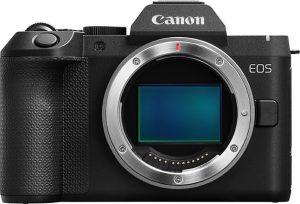
Canon U.S.A. has announced the EOS R8 Mark II. The company says it’s the lightest EOS camera with In-Body Image Stabilization (IBIS). The body measures roughly 5.17 x 3.54 x 3.13 inches, and its styling borrows from classic Canon camera design.

Inside is a 24.2-megapixel full-frame CMOS sensor, with standard ISO reaching 102400 for low-light shooting. Canon says the core imaging systems come from its top-tier professional models. The 5-axis IBIS works together with lens stabilization and includes a mode that reduces blur at the edges of the frame on wide-angle lenses. Canon has also added a multi-controller.

Autofocus runs on Dual Pixel CMOS AF II. It covers 100% of the frame and tracks people, animals and vehicles. Canon says it tracks subjects more closely than the original EOS R8, and the camera adds a Register people priority feature.

Shooting speed went up too. The electronic shutter fires at up to 40 frames per second. An optional pre-continuous mode captures up to 20 frames before the shutter button is fully pressed. Uninterrupted JPEG bursts are 58% longer than on the original R8, and RAW bursts are 30% longer.

On the video side, the camera records uncropped 4K 60p oversampled from 6K, plus uncropped Full HD at 180p with Slow and Fast Mode. Wi-Fi 6 speeds up wireless transfers. Live streaming works over USB-C or HDMI, or wirelessly through the Canon Camera Connect and Live Switcher Mobile apps.

For newcomers, there’s Scene Intelligent Auto with Creative Assist, 14 SCN modes and 16 color filters, including new Negative Filmtone and Positive Filmtone settings.

Canon also announced new accessories. The EG-E2 Extension Grip attaches with a turn-dial and gives a taller grip and better balance with larger lenses, without blocking the battery or tripod mount. The Speedlite EL-5 Ver.2 flash has a longer communication range than the first version and recycles to full power in 1.2 seconds.

A free Windows app, Dual Pixel 3D Converter, can build a 3D photo, a 3D model without a background, or a 3D video clip from a single image. It works with Dual Pixel RAW images from compatible Canon cameras, and with JPEGs shot on the R8 Mark II that include distance information.

The EOS R8 Mark II body is expected in late October at an estimated $1,899, or $2,099 in a kit with the RF24-50mm F4.5-6.3 IS STM lens. The EG-E2 grip ($99.99) and the Speedlite EL-5 Ver.2 ($379) are also expected in late October.

Share

Sony Updates X-OCN White Paper for the FX5 and Adds a Live Production Color Matching Guide

Filmmakers working with Sony’s RAW format have new reading material, and live broadcast crews now have their own guide.

Sony has published two white papers. One is an update to its X-OCN codec documentation. The other is a new guide to color matching for live production.

X-OCN, short for eXtended tonal range Original Camera Negative, is Sony’s compressed RAW format. It records 16-bit linear data, and Sony says that data preserves detail in skin tones, shadows and highlights.

With the release of the Sony FX5, the X-OCN White Paper has moved to Version 3.0. The update covers the new X-OCN C1 and X-OCN C2 formats. Both produce smaller files, and Sony points to uses like web advertising, promotional video and independent film.

The second paper is aimed at live production. According to Sony, crews covering live events increasingly want cameras that give broadcasts a more cinematic look. The new guide lays out methods for keeping color consistent on those shoots. It focuses on productions that mix Sony’s Live System (HDC) cameras with Cinema Line cameras, and it explains how to adjust Cinema Line cameras to match HDC cameras used as the color reference.

Sony says it will keep updating its documentation as camera and image pipeline technology changes. Both papers are available in a new White Papers and Guides section on the Sony Cine website.

Share

Tamron’s 12-20mm F2.8 Ultra-Wide Zoom Comes to Sony E-Mount and Nikon Z Mount

A 12mm field of view with an F2.8 aperture at every focal length, in a lens that weighs about 1.25 pounds.

Tamron has launched the 12-20mm F2.8 (Model A084), an ultra-wide zoom for Sony E-mount and Nikon Z mount full-frame mirrorless cameras. The aperture stays at F2.8 across the full zoom range, and Tamron is pitching the lens for astrophotography and interior shooting.

The lens has 17 elements in 12 groups. Among them are an XGM (eXpanded Glass Molded Aspherical) element, three GM aspherical elements and several special elements. Tamron says the design reduces blur and color fringing at the edges of the frame and corrects sagittal coma flare, a common problem in astrophotography.

The Sony E-mount version is 119.3mm (4.7 inches) long and weighs 570g (20.2 ounces). The Nikon Z version is 121.3mm long and weighs 585g. Both have a range of switches and rings for hands-on control.

Autofocus runs on Tamron’s VXD linear motor. The lens focuses as close as 0.18m (7.1 inches) at the 12mm end.

The lens uses a 12-blade circular aperture, and it’s compatible with the TAMRON Lens Utility software for video and stills. The lens hood is built in, so filters go in an integrated rear filter holder. It also has a moisture-resistant build, a fluorine coating, a locking front cap and an included wrapping cloth.

The Sony E-mount version goes on sale July 30, 2026, and the Nikon Z mount version follows on August 27, 2026.

Share

Nikon Tour Doubles to 10 U.S. Cities in 2026, With Free Workshops and New Learning Tracks

Nikon is expanding the Nikon Tour, its free, in-person event series for photographers and filmmakers. After its first run, the tour is doubling its stops to reach 10 cities across the U.S.

This year’s tour adds programming days built for different skill levels. “Intro to Photography” is aimed at beginners, while “Z Day” and “NIKKOR Z Lens Day” are designed for professional photographers and cinema creators. A new video-focused day centers on the Nikon ZR.

Each stop mixes hands-on photo and video shooting with educational sessions and interactive workshops. Attendees get to try the latest Nikon gear and keep the content they create. The tour is free to attend.

Select stops will feature Nikon Ambassadors D’Ann Boal and Kristi Odom, along with creators Joyce Charat, Staci Brucks and Kirill Umrikhin. Other ambassadors, creators and special guests will lead photo walks and on-site experiences in different cities.

The custom yellow SUV will anchor select stops as a mobile hub. Nikon teams and Ambassadors will use it to bring gear straight to attendees and set up shooting opportunities on location.

The tour opens in Chapel Hill, North Carolina, from May 15 to 17 at the Beautiful Together Animal Sanctuary. Nikon Ambassador Tamara Lackey leads the first stop.

Share

Adobe Jacks Up Creative Cloud Prices, Here’s What Indie Creators Need to Know

Adobe just dropped a bomb on Creative Cloud subscribers. The company’s rebranding Creative Cloud All Apps as “Creative Cloud Pro” and bumping the price to $69.99/month, a significant jump from the current pricing.

The change hits existing subscribers in April 2026.

Here’s the deal. Adobe’s spinning this as adding value, unlimited AI generations, premium features like text-to-video in Firefly, access to partner AI models from Google, OpenAI, and Flux, plus something called Firefly Boards for collaborative mood boarding. You still get all the core apps: Photoshop, Illustrator, Premiere Pro, Lightroom, Adobe Express, and the usual 30,000+ fonts and stock assets.

But let’s be real. For indie creators already stretching budgets, this stings.

Adobe knows it too. They’re offering a cheaper alternative called Creative Cloud Standard. It includes the desktop apps, Photoshop, Illustrator, Lightroom, Premiere Pro, but with limited AI features and restricted access to web and mobile apps. No word yet on what that plan costs, but it’s clearly positioned as the budget option.

The AI stuff is the main differentiator. Creative Cloud Pro gets unlimited standard AI generations and premium features like video generation. Standard plan? Limited AI access. Adobe’s basically saying if you want to use their generative tools seriously, you’re paying the premium.

For working creatives who depend on these tools daily, the price hike is a tough pill. Adobe’s betting that the AI features justify the increase, but plenty of artists and filmmakers are already exploring alternatives, Affinity, DaVinci Resolve, open-source options.

The indie community has always found ways to work around corporate price increases. This might just accelerate that trend.

Existing subscribers can manage or cancel their plans anytime through their Adobe Account. The company’s offering support and FAQs for anyone with questions, but the bottom line is clear: pay more or lose features.

Share

Live Nation to Present at Morgan Stanley TMT Conference

live-nationLive Nation Entertainment will participate in Morgan Stanley’s annual Technology, Media & Telecom Conference next month, one of the industry’s more closely watched investor events.

Joe Berchtold, the company’s president and chief financial officer, is scheduled to speak on March 3, 2026 at 1:05 p.m. PT.

The session will be available via live webcast through the investor section of Live Nation’s website, where executives are expected to discuss business performance and outlook.

Live Nation trades on the New York Stock Exchange under the ticker LYV.

Share
Page 1 of 24
1 2 … 24