

Adobe and Google Partner to Embed AI and Creative Tools Across Each Other’s Platforms

adobe-and-googleAdobe and Google announced an expanded partnership at Adobe MAX to integrate their creative, productivity, and AI tools across both companies’ platforms.

Acrobat will appear in Google Workspace, with direct access from Google Drive and Gmail. Google’s Gemini models will power AI features in Acrobat, including conversational PDF editing and document generation. Adobe’s creative tools will expand into Gemini, Gemini Enterprise, and AI Mode in Google Search, letting users edit images and PDFs inside those platforms.

Google’s latest image and video models, including Gemini Omni, Veo, and Nano Banana, will come to Adobe Firefly, Photoshop, Express, and Premiere. Adobe and Google DeepMind will also collaborate on new editing features for Photoshop, exploring a customized Google image model that could enable near-real-time, prompt-based edits.

“Our expanded partnership combines Google’s frontier AI with Adobe’s industry-leading creative and productivity tools at global scale,” said Anil Chakravarthy, president and incoming CEO of Adobe.

Thomas Kurian, CEO of Google Cloud, said the partnership gives creators and enterprise teams an integrated environment to turn ideas into content.

Adobe’s creative and productivity tools reach more than 1 billion monthly users. More than 400 billion PDFs are opened with Acrobat each year.

Share

Sony Rolls Out RIALTO 65 Camera System as VENICE 2 Powers “Lanterns” and “Evil Dead Burn”

Sony’s expanding its Cinema Line with the RIALTO 65 Camera Extension System for the VENICE 2.
The new system pairs a 65mm sensor replacement with an extension setup. Sony tested it in the Arizona desert to see how it handles light, framing, and depth of field at large format scale.

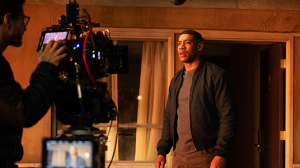
Meanwhile, the VENICE 2 and RIALTO Mini are already on set for HBO’s “Lanterns.” Oscar-nominated cinematographer Florian Hoffmeister shot the opening episodes before handing off to Emmy-nominated DPs Armando Salas and Gregory Middleton. The series follows Hal Jordan as he trains a new Green Lantern, mixing Middle America grit with alien worlds.

Philip Lozano used the VENICE 2 and RIALTO Mini on “Evil Dead Burn,” the sixth feature in the franchise. Director Sébastien Vaniček told Lozano he wanted “the most violent Evil Dead ever done.” Lozano says the camera helped capture fire detail and Vaniček’s handheld style.

Sony also launched the FX5, a full-frame camera that combines RAW recording with a compact body and AI autofocus. Factory shipment has resumed. The company released two new remote control units, the RM-DP5 and RM-DP7, which work as monitors for the FX5, FX3, FX2, and FX30.

Share

ARRI Releases Film Lab 1.5 Plugin with Multi-Format Support

ARRI released Film Lab 1.5, a major update to its OpenFX plugin that brings analog film looks to digital images.
The update adds 8mm, 16mm, 35mm, and 65mm film format options. Previous versions were based only on 35mm film. New parameters give users finer control over grain, halation, and anamorphic character. Processing speed is now up to four times faster.

The company also shared behind-the-scenes insights from recent productions. Cinematographer Johanna Coelho AFC discussed shooting seasons one and two of the Emmy-winning series “The Pitt” with the ALEXA Mini LF at an ARRI event.

ALEXA 35 Live cameras are increasingly used for high-profile live productions. Channel Aid captured Kontra K and the Lufthansa Orchestra live in Hamburg with five ALEXA 35 Live cameras, streaming to more than 200 cinemas with live color grading in the OB van. ARRI’s Multicam System was used for Shakira’s “Las Mujeres Ya No Lloran” world tour show in Madrid and the 2026 Victoria’s Secret Fashion Show in Los Angeles, which streamed live to AMC cinemas for the first time.

Cinematographer Tudor Vladimir Panduru RSC spoke about shooting Cannes Palme d’Or winner “Fjord” with the ALEXA 35 in Norway. Director Cristian Mungiu’s film won the festival’s top prize this year.

ARRI is sponsoring Camerimage 2026 in Toruń, Poland, November 7 through 14.

Share

Canon’s Cinema EOS System Turns 15, With 17 Cameras and 53 Lenses Released

cinema-EOS-SystemA camera system that began after filmmakers started shooting video on a stills camera is turning 15.
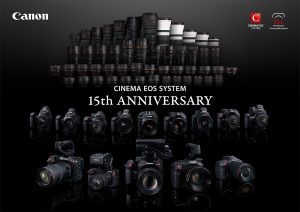
Canon Inc. is marking the 15th anniversary of its Cinema EOS System in November 2026. The line launched in 2011 for professional video production. Since then, Canon has released 17 Cinema EOS cameras and 53 Cinema EOS lenses worldwide.

The system started with the EOS 5D Mark II. Filmmakers took to that camera’s Full HD video mode, and Canon decided to go into video production in a bigger way. Before building a new system, the company talked with filmmakers and video professionals about how they shoot, their workflows and the features they needed.

The first models were the EOS C300 and EOS C300 PL digital cinema cameras in 2011. The EOS C500 followed in 2012. Later cameras like the EOS C400 and EOS C80 used modular designs that can be configured for different kinds of shoots. The EOS R5 C and EOS C50 are more compact. Canon has also added support for newer workflows, including cinematic live production.

Over 15 years, Canon says it has focused on compact, lightweight designs, simple operation and more creative freedom, and it has worked closely with industry professionals along the way. Cinema EOS gear now shows up on films, TV dramas, documentaries, live streams, corporate video and virtual production.

Cinema EOS products were used on All the Empty Rooms, which won the 2026 Academy Award for Best Documentary Short Film. They were also used on All That Breathes, which received top documentary honors at both the Cannes and Sundance film festivals.

Share

Jet2 Partners with Adobe to Build AI-Powered Holiday Planning Tools

ADOBE-JET-2UK tour operator Jet2 is teaming up with Adobe to bring personalized AI features to its 10 million customers.

The multi-year partnership centers on Adobe CX Enterprise Coworker, which uses AI to help Jet2 staff deliver customized travel recommendations at scale. The system will suggest destinations based on each customer’s booking history and preferences, from family resorts to city breaks, and create daily itineraries for travelers already on vacation.

Jet2 will also use Adobe’s content tools to produce on-brand material faster. Adobe Firefly Foundry lets the company build custom AI models trained on its own assets, while Adobe Brand Intelligence keeps outputs consistent across platforms.

A new joint Customer Experience Lab will bring Adobe engineers and Jet2’s digital teams together to test and build new AI services, like smarter ways to match travelers with trips that fit their style.

“Customers know they will always receive a VIP experience when they holiday with us,” said David Hills, Jet2’s chief customer officer. “Working with Adobe will enable us to serve our customers even better, using the power of AI to make every interaction more personal, more relevant, more timely and always helpful.”

Jet2 is the UK’s largest tour operator and third largest airline, flying from 14 UK airports.

Share

Brazilian Broadcast Demo Shows Two Signals Can Share One Frequency

Researchers just pulled off something that could change how TV broadcasts work. At a symposium in Brazil this summer, a team showed they could decode a weaker broadcast signal while canceling out a much stronger one on the same frequency, in real time.
The demo happened at the IEEE International Symposium in João Pessoa in July. Mackenzie Presbyterian University ran the test using tech from labs in Spain, China, Korea, and Canada. The weaker signal they decoded was 37 decibels below the stronger one, a huge power gap.

Why does this matter? Spectrum is expensive and limited. If stations can overlap geographically on the same frequency without interference, that opens up room for local content and more efficient networks. It’s a big deal for the next-gen ATSC 3.0 standard.

Madeleine Noland, president of ATSC, says the demo shows how broadcast tech is evolving beyond traditional TV. Brazil’s been pushing hard on this, with pilots running in Brasília, São Paulo, and Rio de Janeiro.

The work proves that international collaboration can move lab experiments into real-world use. For indie creators and small broadcasters, more efficient spectrum could mean more access and opportunity.

Share

Free TV Gets Cheaper: Broadcast Industry Pushes Toward Affordable NEXTGEN Converter Boxes

The shift to next-generation over-the-air TV just got easier on the wallet.
Pearl TV announced major progress on making NEXTGEN TV converter boxes more affordable, a critical step in moving U.S. households from the old ATSC 1.0 standard to the new ATSC 3.0. The initiative brings together patent holders, tech licensors, testing labs, and security providers, all cutting costs to support cheaper devices that’ll plug into existing TVs.

NEXTGEN TV now reaches 78 markets and over 75% of U.S. TV households. More than 19 million compatible sets have shipped since rollout began. But converter boxes mean viewers don’t need a new TV to access the upgraded broadcasts.

“A successful transition requires affordable products that enable all consumers to continue enjoying free over-the-air television,” says Anne Schelle, Pearl TV’s managing director.

The boxes will support advanced emergency alerts with richer, geo-targeted info and a consistent interface across channels. That framework came out of Sinclair and ONE Media’s work with the NAB NextGen TV News Technology Lab.

And the picture’s only getting better. HDR services are live now for 80 million viewers. Native HDR for sports and entertainment rolls out later this year, with 4K Ultra-HD broadcasts expected in 2027.

New converter boxes should hit retail in early 2027. For an industry preparing to transition more than 1,600 commercial stations, affordable gear matters.

Share

Emmy and Tony Winner Simon Horsman to Discuss AI Script Platform Quilty at Carmel Film Festival

Emmy and Tony Award-winning producer Simon Horsman will lead a panel on AI in Hollywood at the Carmel International Film Festival on October 2.

Horsman is co-founder and CEO of Quilty, a platform that analyzes screenplays using what the company calls non-generative AI. The tool evaluates scripts for story craft, market fit, casting, budget, and production considerations, delivering a Quilty Score in under an hour.

The platform encrypts scripts in transit and at rest, and says it never shares them with third parties or uses them to train AI models. Beyond script analysis, Quilty includes a trend explorer, industry directory, festival and market guide, and a discovery platform that connects writers with verified buyers.

Horsman will appear alongside Griffin Jacques, Quilty’s director of strategic planning and business development, at 10:30 a.m. at Founders Theatre in Carmel-by-the-Sea.

Horsman won the Dramatic Special Jury Award for Creative Vision at Sundance in 2023 for Magazine Dreams. He co-founded LAMF (Los Angeles Media Fund) in 2012, which financed and produced projects with budgets exceeding $350 million. He also co-founded Very Tall Productions, which produced the Daytime Emmy-winning Red Table Talk.

Quilty launched in March and struck a preferred-look deal with Giovanni Entertainment in June, according to Variety. Co-founder Daniel Wood serves as CTO and CPO.

The panel is open to all festival pass holders.

Share

Canon’s EOS R8 Mark II Is the Lightest EOS Camera With In-Body Stabilization

Canon-EOS-R8-Mark-II-

Canon-EOS-R8-Mark-II

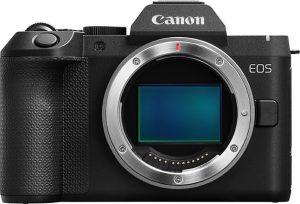
Canon U.S.A. has announced the EOS R8 Mark II. The company says it’s the lightest EOS camera with In-Body Image Stabilization (IBIS). The body measures roughly 5.17 x 3.54 x 3.13 inches, and its styling borrows from classic Canon camera design.

Inside is a 24.2-megapixel full-frame CMOS sensor, with standard ISO reaching 102400 for low-light shooting. Canon says the core imaging systems come from its top-tier professional models. The 5-axis IBIS works together with lens stabilization and includes a mode that reduces blur at the edges of the frame on wide-angle lenses. Canon has also added a multi-controller.

Autofocus runs on Dual Pixel CMOS AF II. It covers 100% of the frame and tracks people, animals and vehicles. Canon says it tracks subjects more closely than the original EOS R8, and the camera adds a Register people priority feature.

Shooting speed went up too. The electronic shutter fires at up to 40 frames per second. An optional pre-continuous mode captures up to 20 frames before the shutter button is fully pressed. Uninterrupted JPEG bursts are 58% longer than on the original R8, and RAW bursts are 30% longer.

On the video side, the camera records uncropped 4K 60p oversampled from 6K, plus uncropped Full HD at 180p with Slow and Fast Mode. Wi-Fi 6 speeds up wireless transfers. Live streaming works over USB-C or HDMI, or wirelessly through the Canon Camera Connect and Live Switcher Mobile apps.

For newcomers, there’s Scene Intelligent Auto with Creative Assist, 14 SCN modes and 16 color filters, including new Negative Filmtone and Positive Filmtone settings.

Canon also announced new accessories. The EG-E2 Extension Grip attaches with a turn-dial and gives a taller grip and better balance with larger lenses, without blocking the battery or tripod mount. The Speedlite EL-5 Ver.2 flash has a longer communication range than the first version and recycles to full power in 1.2 seconds.

A free Windows app, Dual Pixel 3D Converter, can build a 3D photo, a 3D model without a background, or a 3D video clip from a single image. It works with Dual Pixel RAW images from compatible Canon cameras, and with JPEGs shot on the R8 Mark II that include distance information.

The EOS R8 Mark II body is expected in late October at an estimated $1,899, or $2,099 in a kit with the RF24-50mm F4.5-6.3 IS STM lens. The EG-E2 grip ($99.99) and the Speedlite EL-5 Ver.2 ($379) are also expected in late October.

Share

Sony Updates X-OCN White Paper for the FX5 and Adds a Live Production Color Matching Guide

Filmmakers working with Sony’s RAW format have new reading material, and live broadcast crews now have their own guide.

Sony has published two white papers. One is an update to its X-OCN codec documentation. The other is a new guide to color matching for live production.

X-OCN, short for eXtended tonal range Original Camera Negative, is Sony’s compressed RAW format. It records 16-bit linear data, and Sony says that data preserves detail in skin tones, shadows and highlights.

With the release of the Sony FX5, the X-OCN White Paper has moved to Version 3.0. The update covers the new X-OCN C1 and X-OCN C2 formats. Both produce smaller files, and Sony points to uses like web advertising, promotional video and independent film.

The second paper is aimed at live production. According to Sony, crews covering live events increasingly want cameras that give broadcasts a more cinematic look. The new guide lays out methods for keeping color consistent on those shoots. It focuses on productions that mix Sony’s Live System (HDC) cameras with Cinema Line cameras, and it explains how to adjust Cinema Line cameras to match HDC cameras used as the color reference.

Sony says it will keep updating its documentation as camera and image pipeline technology changes. Both papers are available in a new White Papers and Guides section on the Sony Cine website.

Share
Page 1 of 3
1 2 3